updates
What is the use of dissipation factor?
Written by David Osborn — 0 Views
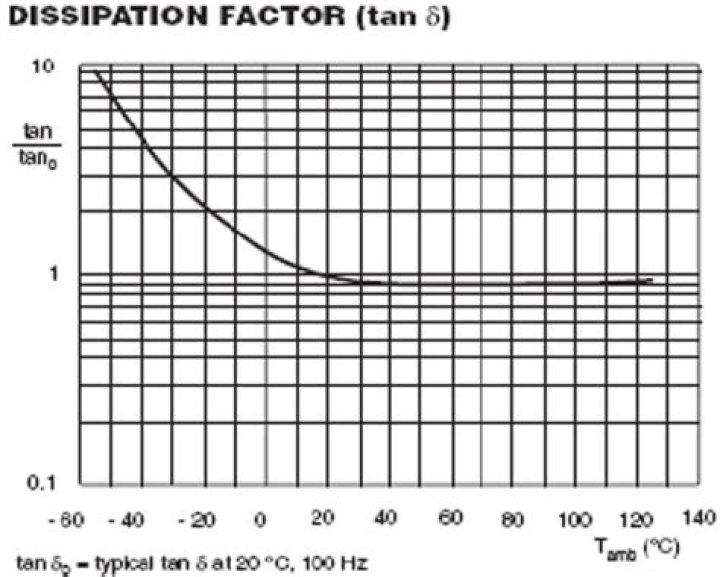
Dissipation factor is defined as the reciprocal of the ratio between the insulating materials capacitive reactance to its resistance at a specified frequency. It measures the inefficiency of an insulating material.
Why is the dissipation factor of a capacitor important?
A high dissipation factor may lead to diminished life of the capacitor and cause deterioration of electrical properties of other components affected by the temperature increase. This temperature increase can be maintained with add on components such as fans and heat sinks but will add weight and cost.What is a good dissipation factor for a capacitor?
1 ( 10%) or less, a ratio figure known as the "dissipation factor" (DF) is more commonly used.What is dissipation factor and quality factor?
In physics, the dissipation factor (DF) is a measure of loss-rate of energy of a mode of oscillation (mechanical, electrical, or electromechanical) in a dissipative system. It is the reciprocal of quality factor, which represents the "quality" or durability of oscillation.What is dissipation factor in PCB?
Dissipation factor, also known as loss tangent, is a printed-circuit-board (PCB) material parameter probably often overlooked when engineers size up their possible choices for PCB materials. But it is a parameter that can tell a great deal about how a material will perform in different applications and environments.#45: Relationship Between ESR, Loss Tangent, Dissipation Factor, and Q
What is meant by dissipation factor?
Dissipation factor is defined as the reciprocal of the ratio between the insulating materials capacitive reactance to its resistance at a specified frequency.What is Dk and Df?
The term "Dk" refers specifically to the real part of the dielectric constant (i.e., the refractive index), while the term "Df" refers to the imaginary part. Note that the imaginary part of the dielectric constant only determines losses, while the real and imaginary parts collectively determine dispersion.What is dissipation factor of transformer?
The dielectric dissipation factor tan δ measured with a Baur DTL-C provides information on the extent of dielectric losses in the transformer oil occurring during operation. It is defined as the ratio between the active and reactive currents flowing in a measurement circuit.What is dissipation factor in tan delta?
In another way, the healthiness of an electrical insulator can be determined by the ratio of the resistive component to the capacitive component. For good insulator, this ratio would be quite low. This ratio is commonly known as tanδ or tan delta. Sometimes it is also referred to as dissipation factor.Why is Q factor important?
Bandwidth: The bandwidth of the tuned circuit reduces when the quality factor Q increases. As losses decrease so the tuned circuit becomes sharper as energy is stored better in the circuit.What is dissipation factor in dielectric analysis?
Dissipation factor is defined as the reciprocal of the ratio between the insulating materials capacitive reactance to its resistance at a specified frequency. It measures the inefficiency of an insulating material.Why is tangent loss important?
In short, the dielectric loss tangent will limit the useful length of a transmission line on a PCB as it causes the signal level to decrease during propagation.What does a high Q factor mean?
Q factor describes if an oscillator or resonator is underdamped, overdamped, or critically damped. Higher Q indicates that the oscillations die out more slowly (a lower rate of energy loss relative to the stored energy of the resonator).What is capacitance and dissipation factor test?
The capacitance and dissipation factor measurement is a popular and proven test to determine the losses in a rotating machine insulation system. An ideal insulation with negligible losses can be modelled as a capacitor that draws a current which is 90° leading with respect to the applied voltage.What is D in capacitance measurement?
D, the dissipation factor, is a value that represents the tendency of an insulating or dielectric material to absorb some of the energy in an AC signal. Q, the quality factor, is the inverse of D. G is the equivalent parallel conductance measured with the parallel equivalent circuit model.Why is dissipation factor negative?
THE NEGATIVE DISSIPATON FACTORAs the dissipation factor indicates the quality of insulation materials by the tangent of the ratio of resistive current IR to capacitive current IC, a negative dissipation factor would imply a negative resistive current, which is physically impossible.