general
What does chromosome deletion cause?
Written by Christopher Snyder — 0 Views
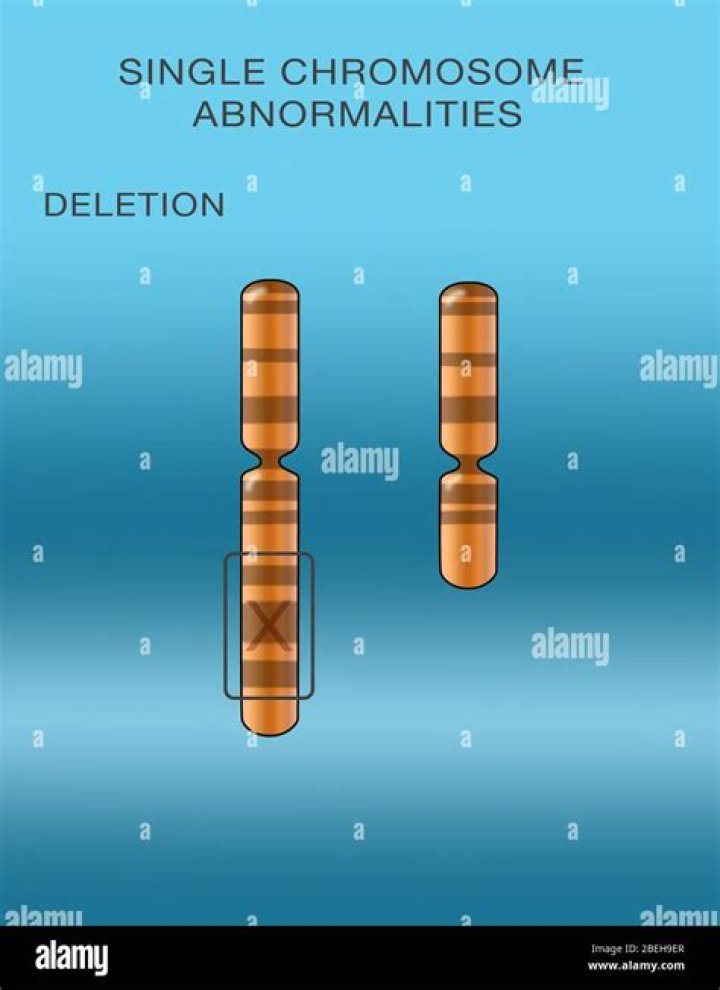
Chromosomal deletion syndromes result from loss of parts of chromosomes. They may cause severe congenital anomalies and significant intellectual and physical disability.
What genetic disorders are caused by chromosomal deletion?
Chromosomal Deletion Syndromes
- 5p- syndrome (5p minus syndrome or cri-du-chat syndrome)
- 4p- syndrome (4p minus syndrome or Wolf-Hirschhorn syndrome)
- Subtelomeric deletions.
What happens in a chromosomal deletion event?
Deletions occur when a chromosome breaks and some genetic material is lost. Deletions can be large or small, and can occur anywhere along a chromosome. Duplications. Duplications occur when part of a chromosome is abnormally copied (duplicated).What are the symptoms of chromosome deletion?
Patients with chromosome 4q deletion may have the following symptoms: unusual skull shape, short nose with unusual bridge, low-set ears that may not have formed well, cleft in the roof of the mouth, short breastbone, poor or delayed growth, moderate to severe intellectual disability, heart defects, unusual heart rhythm ...What effect can chromosome deletion have on a human?
Chromosomal deletion syndromes result from loss of parts of chromosomes. They may cause severe congenital anomalies and significant intellectual and physical disability.Chromosome 22q11.2 Deletion Syndrome: An Introduction to Medical Issues
What does a missing chromosome mean?
Monosomy means that a person is missing one chromosome in the pair. Instead of 46 chromosomes, the person has only 45 chromosomes. This means a girl with TS has only one X chromosome in her 23 rd pair. Sometimes an error occurs when an egg or sperm cell is forming. This causes it to have a missing sex chromosome.Why is deletion mutation harmful?
Because an insertion or deletion results in a frame-shift that changes the reading of subsequent codons and, therefore, alters the entire amino acid sequence that follows the mutation, insertions and deletions are usually more harmful than a substitution in which only a single amino acid is altered.What happens with a deletion mutation?
A deletion mutation occurs when part of a DNA molecule is not copied during DNA replication. This uncopied part can be as small as a single nucleotide or as much as an entire chromosome. The loss of this DNA during replication can lead to a genetic disease.Is deletion worse than insertion?
In case of deletion or insertion of a particular fragment of the gene, deletion could be more harmful than insertion, because the deleted fragment of the gene will never be replaced at exact size and exact position of the disabled gene.What is the most harmful mutation?
Deletion mutations, on the other hand, are opposite types of point mutations. They involve the removal of a base pair. Both of these mutations lead to the creation of the most dangerous type of point mutations of them all: the frameshift mutation.What are the 4 types of chromosomal mutations?
The four main types of structural chromosomal aberrations are deletion, duplication, inversion, and translocation. Deletions occur when a portion of the chromosome is deleted, or taken out, which can make that chromosome less functional.What are the 3 main problems that can happen to the DNA strand?
There are three types of DNA Mutations: base substitutions, deletions and insertions.What is the most common genetic mutation?
The 7 Most Common Genetic Disorders
- Down Syndrome. When the 21st chromosome is copied an extra time in all or some cells, the result is down syndrome – also known as trisomy 21. ...
- Cystic Fibrosis. ...
- Thalassemia. ...
- Sickle Cell Anemia. ...
- Huntington's Disease. ...
- Duchenne's Muscular Dystrophy. ...
- Tay-Sachs Disease.
Which of the following diseases is caused by chromosomal mutation?
Chromosomal disordersDown syndrome (Trisomy 21). FragileX syndrome. Klinefelter syndrome. Triple-X syndrome.