general
How common is jail time for tax evasion?
Written by James Rogers — 0 Views
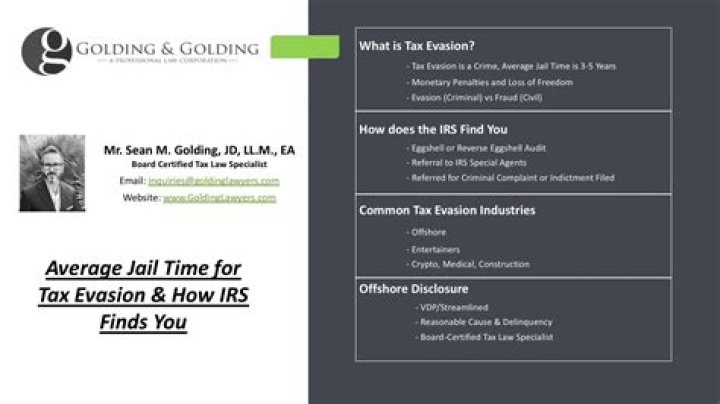
Overall, the average jail time for tax evasion is three to five years. Still, you need to keep in mind that in most cases, tax evasion will lead to (considerable) penalties instead of jail time. To go to jail, criminal charges need to be filed against you, and, in the majority of situations, this will not be the case.
Does everyone go to jail for tax evasion?
But here's the reality: Very few taxpayers go to jail for tax evasion. In 2015, the IRS indicted only 1,330 taxpayers out of 150 million for legal-source tax evasion (as opposed to illegal activity or narcotics). The IRS mainly targets people who understate what they owe.How much time can u get for tax evasion?
Penalty for Tax Evasion in CaliforniaTax evasion in California is punishable by up to one year in county jail or state prison, as well as fines of up to $20,000.
What is jail like for tax evasion?
A felony tax evasion charge is more serious than the misdemeanor charge. If you are convicted of felony tax evasion under section 19706, you face one year in state prison. The fine of $20,000 is the same for a misdemeanor and felony tax evasion conviction under section 19706.How much do you have to owe IRS to go to jail?
In general, no, you cannot go to jail for owing the IRS. Back taxes are a surprisingly common occurrence. In fact, according to 2018 data, 14 million Americans were behind on their taxes, with a combined value of $131 billion!Average Jail Time for Tax Evasion - How IRS Finds You
What triggers an IRS criminal investigation?
Criminal Investigations can be initiated from information obtained from within the IRS when a revenue agent (auditor), revenue officer (collection) or investigative analyst detects possible fraud.What happens if you owe the IRS more than $25000?
Taxpayers may still qualify for an installment agreement if they owe more than $25,000, but a Form 433F, Collection Information Statement (CIS), is required to be completed before an installment agreement can be considered.Can you go to jail for lying on taxes?
Lying on your tax returns can result in fines and penalties from the IRS, and can even result in jail time.Can you go to jail for not filing taxes for 10 years?
Failure to file or failure to pay tax could also be a crime. The IRS recognizes several crimes related to evading the assessment and payment of taxes. Under the Internal Revenue Code § 7201, any willful attempt to evade taxes can be punished by up to 5 years in prison and $250,000 in fines.What happens if you haven't done your taxes in 3 years?
If you don't file within three years of the return's due date, the IRS will keep your refund money forever. It's possible that the IRS could think you owe taxes for the year, especially if you are claiming many deductions. The IRS will receive your W-2 or 1099 from your employer(s).What is the lowest payment the IRS will take?
If you owe less than $10,000 to the IRS, your installment plan will generally be automatically approved as a "guaranteed" installment agreement. Under this type of plan, as long as you pledge to pay off your balance within three years, there is no specific minimum payment required.Can the IRS take your house?
Yes. If you owe back taxes and don't arrange to pay, the IRS can seize (take) your property. The most common “seizure” is a levy.What do I do if I owe the IRS over 100000?
The IRS may take any of the following actions against taxpayers who owe $100,000 or more in tax debt:
- File a Notice of Federal Tax Lien to notify the public of your delinquent tax debt.
- Garnish your wages or seize the funds in your bank account.
- Revoke or deny your passport application.
- Offset your tax refund checks.
How long does a tax investigation take?
Smaller tax investigations usually take between three and six months, while a full-scale investigation can sometimes take up to 16 months to complete.Does the IRS show up at your door?
Revenue agents and revenue officers usually call or send a letter before they show up at your home or business. That's standard operating procedure, so that they spend their time productively with you. Special agents can show up unannounced.How do I know if the IRS is investigating me?
You first contact with a CID agent is initially through an in-person visit at your home or place of business. They will then notify you that you are under criminal investigation by the IRS. Again, you should simply say nothing and immediately notify a qualified IRS tax attorney.Can the IRS make you homeless?
The Status of Your HouseThe IRS does not want to make taxpayers homeless; however, they do need to collect the debt. They might recommend you sell your home in order to pay off your debt, or they might end up seizing it if they feel it is the only way to get paid.